
Resettlement and relatedness among displaced Ukrainian women in Denmark (RE-GENDERING)
This project explores the new phenomenon of “feminized displacement” in the context of Ukrainian women fleeing without men after Russia’s February 2022 invasion.
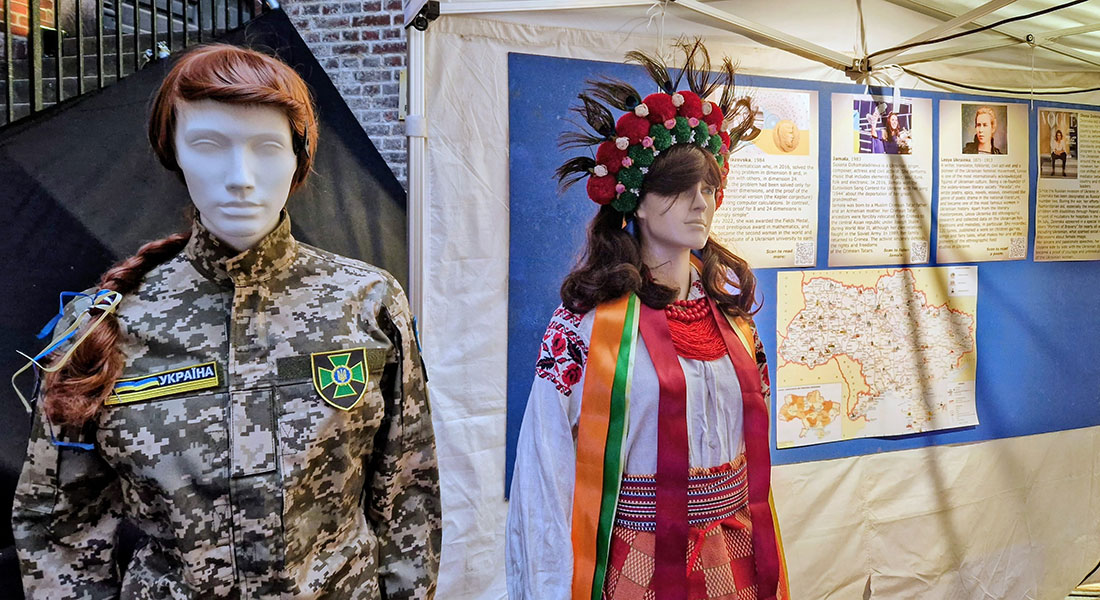
RE-GENDERING studies Ukrainian displaced women’s everyday life, kin relations, and the encounter with Danish institutions locally and Ukrainian institutions transnationally. It focusses on the complexity of new and continuing gender expectations and possibilities through qualitative ethnographic, interviews, and visual methods. The project is divided into three work packages each exploring different perspectives from the women in different positions along with relevant actors that engage with the women on an everyday basis.
The project empirically contributes to understanding the new phenomenon of feminized displacement and conceptually develops a novel analytical framework for understanding “re-gendering” – understood as: The processes of resettling, re-building and remaking of everyday life in the complexity of new and continuing gender expectations and possibilities.
Contrasting earlier patterns of forced migration with men leaving women and children behind, women increasingly flee without male relatives and obtain asylum based on gender under the Refugee Convention. The 2022 Russian invasion of Ukraine has generated its own distinct feminized displacement pattern, with women and children comprising the majority of those who have fled the war. This new feminized displacement has forced women to take on burdens of both care and breadwinning while abroad. This project studies how this this “re-gendering” play out among Ukrainian women in feminized displacement in Denmark, who due to transnational contact with kin and (direct or indirect) affiliation with Ukrainian institutions, live in multiple and contractionary gender political contexts and disputes.
The project is organized into three complementary work packages, focusing on different groups of actors and social settings. WP1 explores women without children, WP2 focusses women with children, and WP3 explores the institutional actors that engage with the women on an everyday basis (e.g., social workers, teachers, children’s teachers, and pedagogues, health care professionals). This division covers critical intersectional differences (e.g., age, life stage, generation) and the different empirical settings of women in everyday life; yet cross-case analyses secure conceptual synergy.
The project is a collaborate project between Centre for Advanced Migration Studies (AMIS) at the Saxo Institute, KU, and the Danish Centre for Social Science Research (VIVE).
- Dr. Strelnyk (Kyiv University - expert on Ukrainian women, motherhood and gender roles),
- Prof. Sjöberg (Director the Gender Institute, University of London),
- Prof. Pratt (University of British Columbia – expert on migration, gender, visual research)
- Senior researcher Johansen (VIVE – expert on migrant-state interaction in Denmark).
- Dr. Babenko (Malmö University – expert on Ukrainian refugees in Europe)
- Dr. Bragg (University of Lethbridge/York – expert on gender, resettlement), and Dr.
- Prof. Triandafyllidou (Chair of the Canada Excellence Research Chair in Migration and Integration (CERC Migration), Toronto Metropolitan University)
Funding
Project PI: Kathrine Vitus (professor, VIVE)
Project period: August 2026 - august 2030.
Researchers
Internal
| Name | Title | Phone | |
|---|---|---|---|
| Borello, Andrea | Postdoc | +4535323538 | |
| Sandberg, Marie | Associate Professor - Promotion Programme | +4551299017 | |
| Varha, Nataliia | Research Assistant | +4535322774 | |
| Whyte, Zachary | Associate Professor | ||
| Zaitseva, Yuliia | PhD Student |
External
| Name | Title | Phone | |
|---|---|---|---|
| Vitus, Kathrine | Professor | +4524987238 |